
Source: Tārīkh Tarbiyat Al-Khuyūl Al-ʻArabīyah fī Miṣr by Abd al-‘Alīm ‘Ashoub
I was preparing an article and needed to consult Ashoub’s History of the Royal Agricultural Society’s Stud of Authentic Arabian Horses. Pages 33 and 34 of the Arabic version of the book discuss the crisis faced by the Horse Commission, which was chaired by the late HRH Omar Tousson, when the Ottoman government prohibited the exportation of aseel (asil) horses from the Levant to Egypt. During World War I, the Ottoman government exerted all its efforts to acquire as many horses as possible.
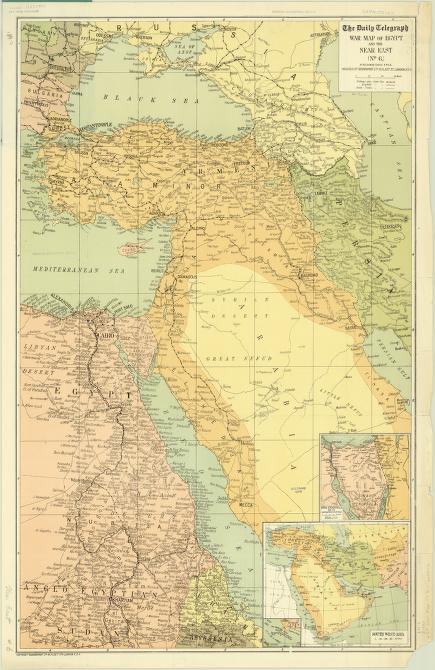
Source: The Library of Congress online website.
In my series of articles titled Horses in Ancient Egypt, I discussed various research papers on the history of horses in Egypt. The Levant and Anatolia played a monumental role in horse breeding in Egypt. They served as a source from which the ancient Egyptians acquired their horse stock. Through Egypt’s Eastern gate, horses were introduced to the Egyptians during the Second Intermediate Period.

Millennia later, the Levant and Anatolia once again would play a crucial role in horse breeding in Egypt. Such influence, on one hand, led to a breeding crisis, while on the other hand, it fostered the development of the world’s most distinguished gene pool of Arabian horses.
The Horse Commission recognized the necessity of acquiring aseel horses to enhance Egypt’s local breed. Since the Ottoman prohibited the exportation of Arabians to Egypt, an alternative approach involved breeding local mares with English stallions, which produced undesirable offspring. It was imperative to obtain Arabian horses at all costs to improve Egypt’s local stock. In 1914, a decision was made to gather all aseel horses in Egypt, owned by Abbas Hilmi II, HRH Prince Mohamed Ali Tewfik, and Lady Ann Blunt, and to select studs from this pool for breeding with local Egyptian stock. The Royal Agricultural Society acted on this decision, and since then, the RAS has not found it necessary to import Arabian horses.
 The Horse in Word and Picture
Thank you Ranja for this thoughtful article, I was wondering who were the so-called “local Egyptian mares” to improve to with Asil stallions ? ( a part from the Lady Anne Blunt mares or the mares owned by Egyptian royals).
Did someone managed to take studies, as a genetic research with the MT-DNA of the descendants of these mares?
Thank you very much.
LikeLiked by 1 person
Hello Annalisa! Thank you for reading the piece and for your comment!
What I meant by local Egyptian mares is the local breed commonly known as ‘Baladi’.
LikeLike
The Egyptian government used to assign Arabian studs to breed with local breed of Egypt to improve local stock. That local stock was used in the police force, the army and other entities.
LikeLike
Thank you Ranja for your answer. Maybe these Baladi horses could be the descendants of the English army horses? Or ? What was the origin of these horses?
LikeLike
The local Egyptian breed or the Baladi (an Arabic word which means local) is a very complicated breed not only in terms of its genetic configuration but also in terms of its historical roots. I’ve been researching this breed for quite sometime and travelled to different parts of Egypt. I haven’t come across a research that was as painstaking as this one.
LikeLike
However, in some historical records, this breed had specific physical characteristics, which made it easy to identify it.
LikeLike