
Being wildly passionate about horses and equestrian sports and traditions, I decided to travel to Upper Egypt to explore and photograph its equestrian tradition, known as al-Mirmah. For more than a decade, I have been writing about horses and equestrian history in Egypt in addition to photographing horses. Yet I have never attempted, not even once, to explore equestrian traditions in my homeland.
“Are you going to Upper Egypt all by yourself?! Are you mad?! Somebody has to escort you.” This was the typical reaction of almost everyone whom I consulted about the idea of travelling to Upper Egypt to explore al-Mirmah. It’s a tradition deeply rooted in history practised exclusively by men, which resembles medieval and antique military arts practised in an era where men played a prominent role in fighting battles and protecting land and honour.
There are two types of Mirmah: the first one is a horse race which takes place in the desert and usually found in the cities of Aswan and Isna. The second one is similar to an equestrian tournament combining three disciplines. I became obsessed with the latter and decided to travel to capture it on my camera and to learn more about its origin, history, and rules.
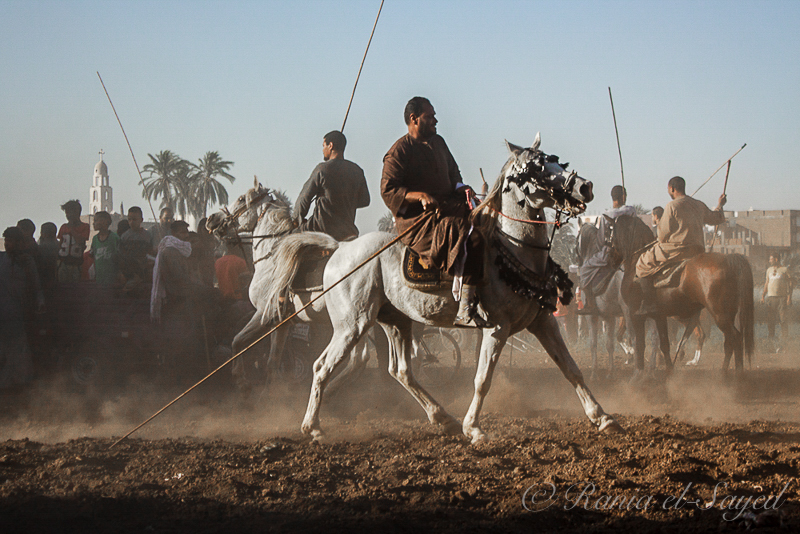
A Cairene woman like myself can face challenges, but not danger, when she decides to tour Upper Egypt on her own. Among these challenges is a conservative society’s perception of a Cairene women as typically dismissive and contemptuous of Upper Egyptian traditions. Another challenge is my presence all by myself among locals photographing and interacting with them while they practice an exclusively male tradition. But there is an important characteristic which ensures the safety of solo travelers like myself: this society is governed by tribal conventions of which protecting women is among the norms that govern such societies.
I read online that the mawlid (festival commemorating a saint or prophet) of Abu al-Hajaj al-Uqsury (who is a renowned saint of Luxor) was approaching. Al-Mirmah takes place four or three days before the actual day of the mawlid, and so I decided to head towards Luxor. “Luxor is ideal if compared to the rest of the cities,” I thought. It is a cosmopolitan city to which people from different ethnic and cultural backgrounds flock to visit the largest repository of ancient Egyptian monuments. The locals must be open-minded compared to the residents of other cities in the region. However, al-Mirmah revealed an aspect of Luxor that remained obscure to me until I travelled there. Conservative locals of Luxor remain attached to the conservative customs and traditions of Upper Egyptian culture.
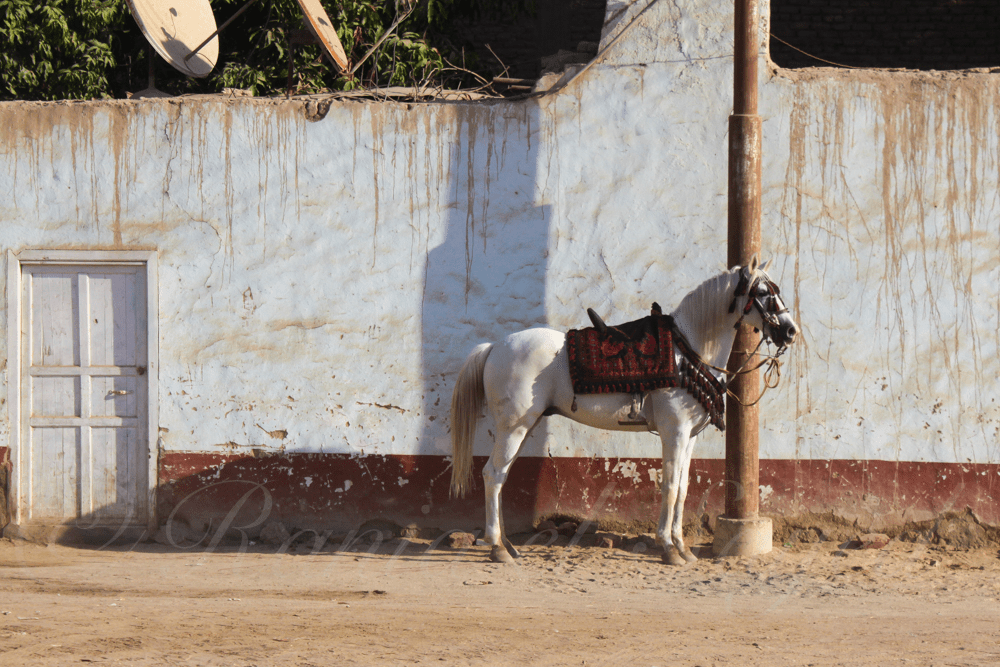
I prepared a conservative wardrobe, since observing modesty when attending al-Mirmah has been insisted on by the locals who would later accompany me to the village where one of the tournaments is regularly organised. They said that they refuse to accompany any female traveller or tourist unless she wears less revealing clothes.
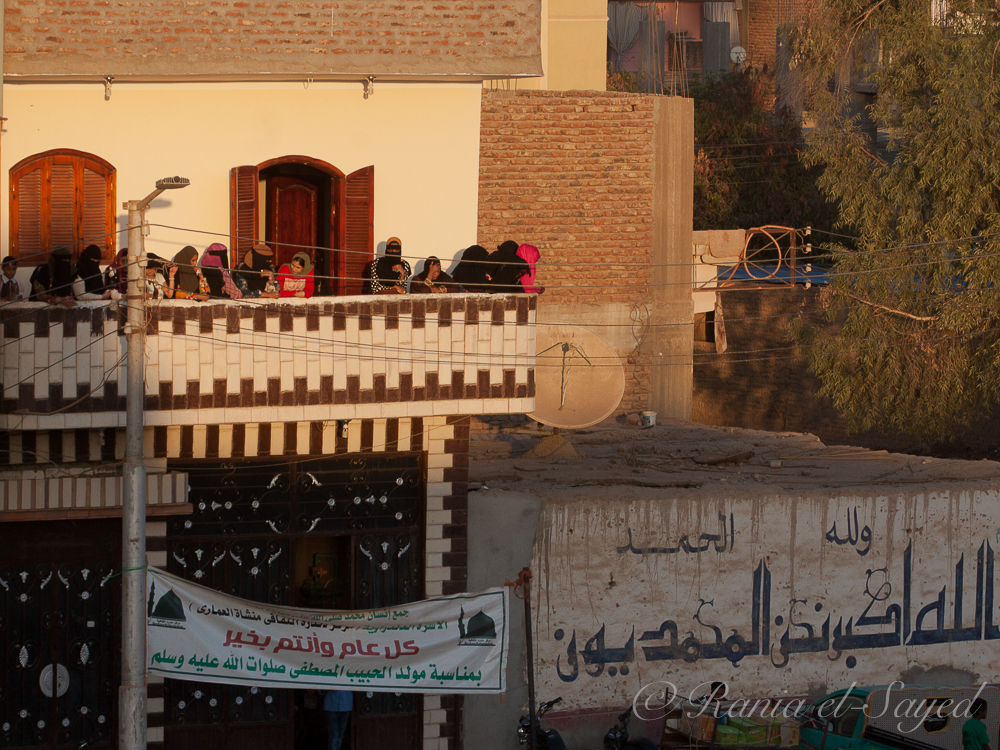
Al-Mirmah highlights the traditional role of men and women. Men mount
their horses to compete in the arena, while women prepare breakfast, clean clothes and recite prayers wishing men of the family success and the blessings of God. Then they return to the kitchen to either prepare the meals or supervise housemaids as they do their chores. Also women are expected to receive female guests who come either to watch al-Mirmah or to socialise on the occasion of the mawlid. I would like to emphasise that some of these women hold university degrees and some have full-time jobs as civil servants. Elite women cover their faces with a full-face veil when they go out in balconies to watch al-Mirmah tournament, while women of lower social status sit on the ground at a distance from the arena to watch the event.
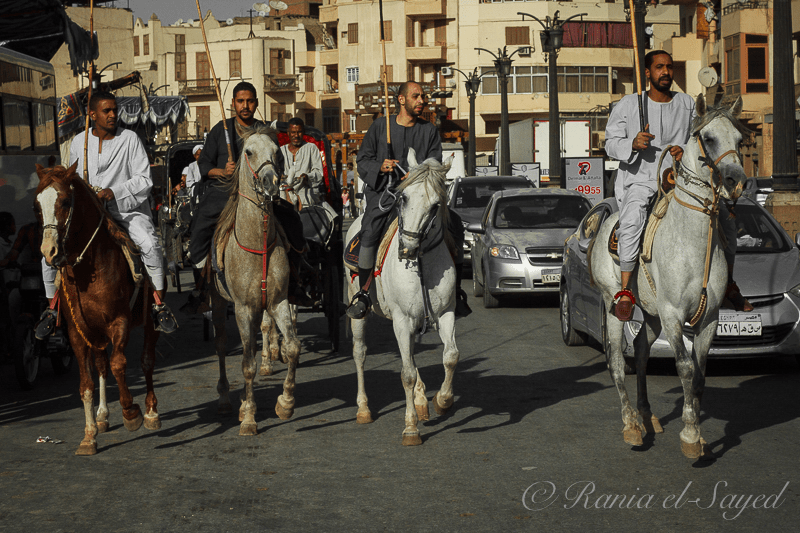
I accompanied riders on their daily journey which starts with a gathering for breakfast, then giving the horses a proper bath, prepare the horse gear, then choose a Jilbab (the traditional attire) that matches the coat colour of the horse.
The riders arrive at the arena either on horseback accompanied by a musical band playing traditional songs, or by pick-up trucks in case the event is organised at a distant village.
Locals take al-Mirmah tournaments very seriously as if they are football matches or Olympic games.
Spectators come from surrounding villages and from those afar. As the final days of the event approach the spectators and riders increase in numbers. Boys and men of all age groups come from neighbouring and distant villages. They line up next to each other creating a human fence seperating the arena from the rest of the surrounding plots of lands and buildings. Few little girls could be seen here and there. They come to enjoy the festive mood of the mawlid, eat candies and ride the swings.
I was the only woman moving inside the arena to capture photographs. My hosts assigned two persons to keep my company. It is dangerous for a person to move around because a rider may lose control over his horse, which does happen, and puts all spectators at danger. One time I was about to get knocked down by a horse whose rider fell off of its back had it not been for my guards who were watching out for my well-being. The audience was very helpful when I wanted to move around in different locations to take photographs, and made space for me whenever I wanted. Sometimes they would give up their seats for me, all which have ascertained what I have heard about the hospitality in Upper Egypt. As for the children attending the event they were curious about what I was doing. At first they thought that I was a Cairene journalist covering al-Mirmah event to write an article, which actually did inspire me to write this article. Others thought I was a foreign horse trainer or horse trader or an animal welfare worker, which are common roles for female expats. But encountering an Egyptian woman who is a solo-traveller and an amateur photographer was not easily absorbed by the locals, because both roles are not traditional from an Upper Egyptian perspective. Nevertheless, the riders were very glad that someone was taking photographs of them while they were in action and demonstrating their horse-riding skills.

On the last day of the al-Mirmah after the event is over, some locals from the hosting village serve traditional cold drinks to visitors who came either to participate or to attend the event. The family hosting al-Mirmah prepares a feast and invites guests over. At night a party is organised to which a renowned singer is invited to sing religious songs praising the saint or the prophet who is celeberated in that mawlid.
Others organise dance parties for horses, a tradition which recently became familiar to Upper Egypt, yet very common in Lower Egypt. This dancing tradition is known as Adab. The culture of horse dancing is frowned upon in some circles in Upper Egyptian society as I’ve heard from a prominent clan member. He said that horses are bred for war or equestrian sports but never for dancing because they consider a horse as a member of the family that should not dance in public and be given noqta, a monetary incentive known among bellydancers. I was invited to one of these parties. Upon my arrival I found out that I was the only woman attending among a huge crowd of men. As usual there was a private space for women in the balconies to watch the party but some preferred to remain indoors, while men reserved a side street to host the party.
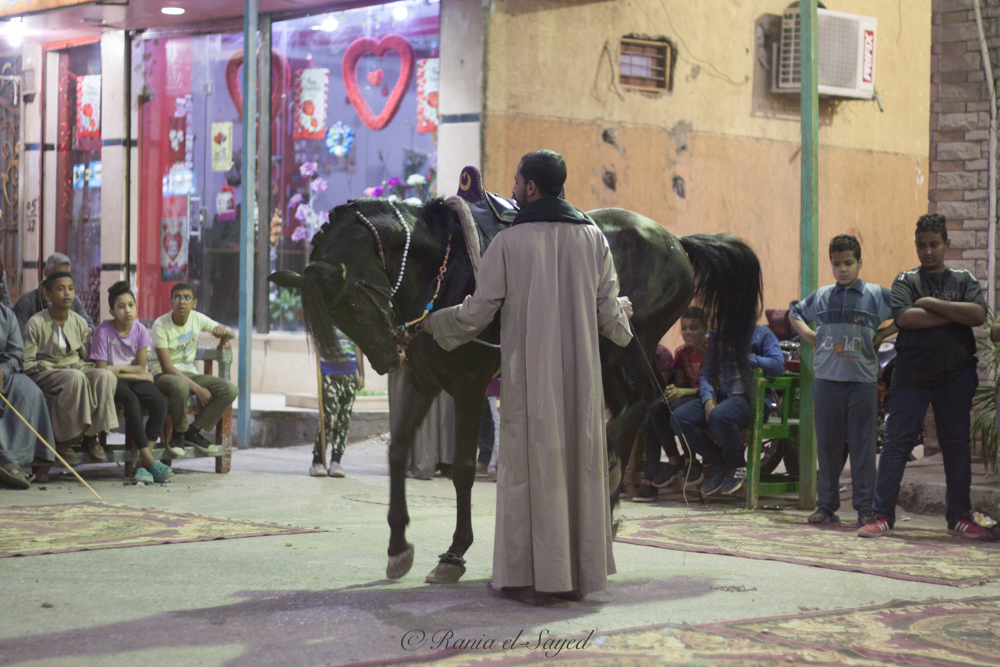
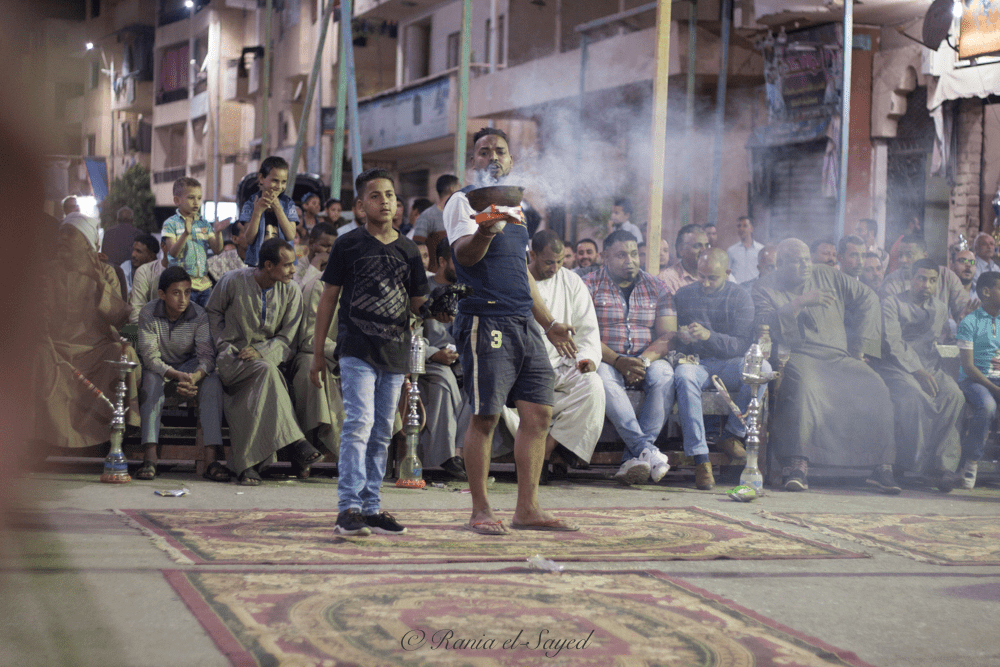
For the first time I watched traditional dancing performed by men where they tie a shawl around their waste and do slight moves with their hips while carrying a stick, which some might mistake it to be bellydancing. To my surprise I was overwhelmed by the ability of Upper Egyptians to create such a festive atmosphere.
Upper Egypt is thought to be regressive, repressive of women and closed to itself. This unilateral judgement is based on citizens of modern societies. My travels to this region opened my eyes to many positive aspects about traditional societies which citizens of the cities certainly miss. Among those aspects is celebrating occasions (be them religious or otherwise) to strengthen social bonds, resolve conflicts and preserve the cultural and social memory of the society.
People of Upper Egypt are tenacious and persevering. Owing to these qualities they were capable of preserving al-Mirmah equestrian tradition, as well as other long-standing customs and traditions some of which date to ancient Egypt.
In Part II I shall discuss in depth this equestrian tradition and the traditional society of Upper Egypt.
The following footage is of a typical Mirmah tournament taken on the occasion of celeberating the birth of Prophet Muhammad. Please beware that this Instagram account is no longer active. To follow me on Intagram, go to THINWP
 The Horse in Word and Picture